CN Electronics
Selecting the right DC/DC-Voltage Regulator is not a minor component decision. It influences efficiency, thermal behavior, battery life, electromagnetic interference, and product reliability. A converter may look suitable on paper, yet fail when airflow is restricted or the load changes sharply. Real hardware is less forgiving.
Recent market studies from MarketsandMarkets and Grand View Research indicate strong, double-digit growth in the DC-DC converter sector. Their findings reflect rising demand from electric vehicles, renewable-energy systems, industrial controls, and compact consumer electronics. However, market growth does not guarantee a correct design choice. Forecasts vary by scope, region, and product definition. That deserves caution.
Robert W. Erickson, a leading power-electronics researcher, states, “The ideal converter is lossless, and the input and output powers are equal.” This principle is simple. Practical regulators always lose energy. The better question is where those losses appear. A 12-volt rail feeding a 5-volt processor may waste little power at light load, then heat rapidly during peak current. A designer should examine input range, output accuracy, transient response, switching frequency, ripple, protection functions, and thermal resistance.
Small details matter. A poorly placed ceramic capacitor can increase ringing. An underrated inductor can saturate near the enclosure’s temperature limit. A low-cost module may meet nominal specifications but offer weak documentation. Engineers should compare independent test data, datasheet limits, and measured performance under realistic conditions. The right DC/DC-Voltage Regulator is not always the most efficient model. Sometimes, simplicity, verified protection, and stable supply availability matter more. That is where careful judgment begins.
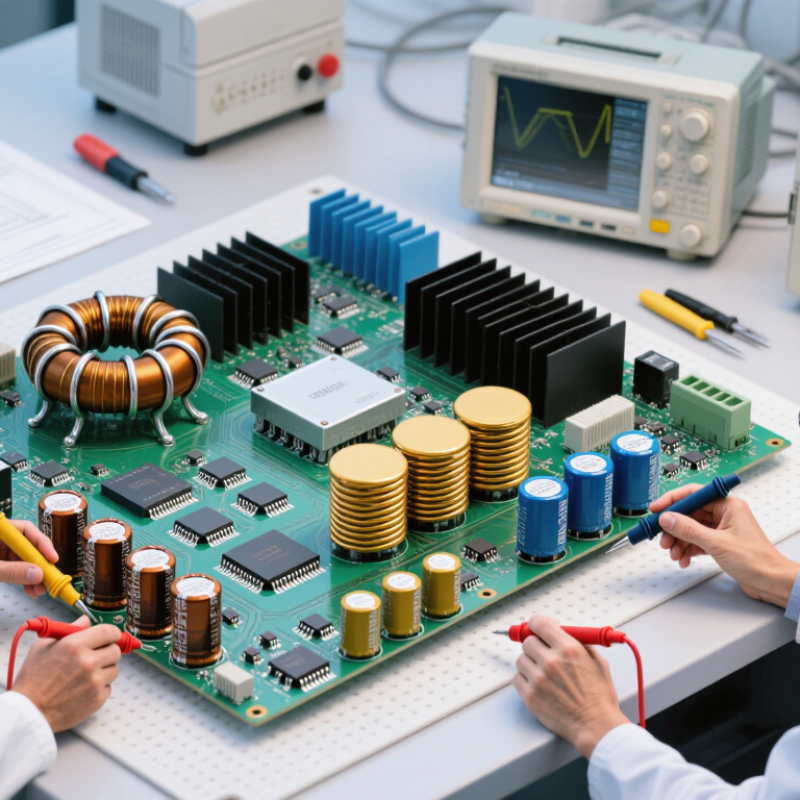
A DC-DC voltage regulator converts one direct-current voltage into another. It controls output voltage despite changing input or load conditions. A buck circuit steps voltage down. A boost circuit raises it. Buck-boost designs handle both conditions. Inside, a switch, inductor, capacitor, and feedback loop work together. The feedback loop samples output voltage and adjusts switching duty cycle. This is the practical meaning of regulation.
For example, a 24-volt industrial rail may supply a stable 5-volt sensor line. Without regulation, cable drops, startup surges, and load changes can disturb measurements. In bench testing, I check ripple with a short probe. Then I monitor temperature after thirty minutes. The first result can mislead. A converter showing 95% efficiency may still create a hot, noisy enclosure. Datasheet values also depend on layout, airflow, load, and temperature.
Choosing correctly matters as electrification expands. The International Energy Agency reported over 17 million electric cars sold worldwide in 2024. That represented more than 20% of new-car sales. These systems need regulated rails for sensors, processors, lighting, and control circuits. The U.S. Department of Energy highlights efficiency, thermal management, reliability, and electromagnetic compatibility in power-electronics research. Engineers should compare input range, output current, transient response, ripple, protection, and standby losses. Test the worst case, not the typical case. A smaller regulator may pass today’s test and fail after heat, dust, or aging. That possibility deserves attention.
A DC-DC voltage regulator converts one direct-current voltage into another. It does this by switching electrical current rapidly, rather than reducing energy as heat. In a buck regulator, a switching element connects the input to an inductor in short pulses. The inductor stores energy, then releases it to the load. A capacitor smooths the resulting waveform. The output becomes usable DC voltage.
A feedback circuit measures the output continuously. If the voltage falls under load, the controller adjusts the switching duty cycle. This increases the energy delivered during each cycle. Boost regulators use a similar process to raise voltage. Buck-boost designs can raise or lower voltage when the input changes. The switching frequency, inductor value, and capacitor quality affect ripple, noise, and response speed. Small changes matter.
In practical testing, a regulator may perform differently from its calculation. Circuit resistance, heat, wiring length, and layout all influence results. A prototype can show unexpected noise near sensitive sensors. That is not always a design failure, but it requires investigation. Engineers usually check efficiency at light and heavy loads, measure temperature, and observe voltage during sudden current changes. Protection features such as overcurrent and thermal shutdown improve reliability. Yet protection cannot fix poor component selection. The best regulator balances voltage accuracy, efficiency, size, heat, and electrical noise for its actual application.
Choosing the right DC-DC voltage regulator begins with understanding its topology. Each type responds differently to input changes, load demand, heat, and electrical noise.
A buck converter reduces voltage efficiently, such as converting 24 V to 5 V for a control circuit. It is usually compact and cool, but its output cannot exceed the input. Keep headroom.
A boost converter raises voltage, which helps power sensors from a low-voltage battery. However, higher output current can increase input current and thermal stress.
A buck-boost converter handles input voltages above or below the target output. This makes it useful in battery-powered equipment, where voltage gradually falls during discharge.
An isolated DC-DC regulator separates input and output electrically through a transformer. It can improve safety and reduce ground-loop problems in sensitive systems. Non-isolated designs are often smaller and more efficient when isolation is unnecessary. Charge-pump converters use capacitors instead of inductors, making them quiet and compact at modest power levels.
Selection should include efficiency, ripple, transient response, switching frequency, and cooling space. Check the inductor and capacitor ratings, not only the regulator’s headline current.
I once focused too heavily on efficiency and underestimated startup surge. The circuit worked on the bench, then failed under a realistic load step. That mistake still matters.
Measure real temperatures and waveforms before finalizing the design.
Why Choose the Right DC-DC Voltage Regulator?
Factors for Selecting the Right Regulator
A DC-DC voltage regulator must match the circuit, not just the label on the power supply. The right choice protects sensitive loads and reduces unexpected redesigns. Start with the input voltage range, output voltage, and required load current. A 12-volt rail may rise above 14 volts in a vehicle system. Measure actual conditions, including startup and shutdown behavior.
The load’s behavior also matters. Peak current can exceed the average by several times. For a motor, relay, or wireless transmitter, check inrush current and transient response. Select the topology carefully. A buck converter reduces voltage, while a boost converter increases it. A buck-boost design handles input levels above and below the output. Efficiency is important, but thermal performance is equally practical. Calculate heat at maximum load, then inspect the enclosure’s airflow and copper area.
Check switching frequency, output ripple, electromagnetic interference, and control-loop stability. In field prototypes, I have seen a regulator pass a bench test but fail after the enclosure warmed up. The shortcut looked reasonable, but the thermal margin was too small. Review overcurrent, overvoltage, short-circuit, and reverse-polarity protection. Overcurrent protection is not enough. Read the electrical characteristics carefully, rather than trusting typical graphs. Then test with an electronic load and oscilloscope. Probe placement can distort ripple readings. A regulator with a wide input range may still perform poorly near its limits. Leave practical margin for aging, wiring loss, and imperfect assumptions.
Choosing the correct DC-DC regulator improves efficiency, thermal control, and system reliability. The IEA’s Energy and AI report estimates that data centers consumed about 415 TWh globally in 2024. That demand may reach 945 TWh by 2030. Every lost watt becomes heat somewhere.
A regulator with 96% efficiency may outperform a 90% option in a high-current rail. In a 12 V to 5 V conversion, that difference can reduce heatsink size and fan noise. Small gains matter.
Correct selection also protects sensitive loads. Check input range, output ripple, transient response, switching frequency, and current headroom. A 3 A load should not use a regulator rated only slightly above 3 A. Leave practical margin.
The Lawrence Berkeley National Laboratory’s 2024 United States Data Center Energy Usage Report projects data centers could consume 6.7% to 12% of U.S. electricity by 2028. Better conversion efficiency can support this growing electrical load. Yet efficiency alone can mislead.
A device may test efficiently at one operating point but perform poorly during startup or light load. Engineers sometimes overlook layout, airflow, and capacitor aging. That mistake is understandable, but expensive. Measure the real load profile before finalizing the design.
It converts one direct-current voltage into another. It keeps output voltage stable during input or load changes. A switch, inductor, capacitor, and feedback loop work together.
A buck regulator lowers voltage. A boost regulator raises voltage. A buck-boost design handles input voltage above or below the output.
The correct choice protects sensitive circuits and reduces redesign risk. It can improve efficiency, temperature control, and reliability. A poor match may pass today and fail later.
Check input range, output voltage, load current, ripple, and transient response. Also review switching frequency and standby losses. Leave margin for wiring loss and aging.
Motors, relays, and transmitters may draw brief peak currents. Their inrush current can exceed average current several times. Check transient response with a realistic load.
Lost energy becomes heat. At high current, a few efficiency points matter. Inspect airflow, enclosure size, copper area, and heat after thirty minutes.
Use an electronic load and an oscilloscope. Test startup, shutdown, maximum load, light load, and input limits. Use a short probe for ripple measurements. Probe placement can distort results.
No. Efficiency may look excellent at one operating point. Startup, light load, heat, and aging can change performance. A 95% result may still mean a hot, noisy enclosure.
A DC/DC-Voltage Regulator is an electronic device that converts one direct-current voltage level into another, providing stable and reliable power for circuits and equipment. It works by controlling the flow of electrical energy through switching, inductive, capacitive, and feedback components. By continuously monitoring the output and adjusting the conversion process, the regulator can maintain a steady voltage even when the input supply or load changes.
The main types include step-down, step-up, and step-up/step-down regulators, each designed for different voltage conversion requirements. Choosing the right regulator depends on input and output voltage ranges, load current, efficiency, heat generation, size, response speed, noise, and protection features. A properly selected DC/DC-Voltage Regulator improves system stability, reduces energy loss, protects sensitive components, and supports longer operating time in battery-powered applications. Careful selection also helps simplify thermal management, enhance reliability, and ensure consistent performance under changing operating conditions.
